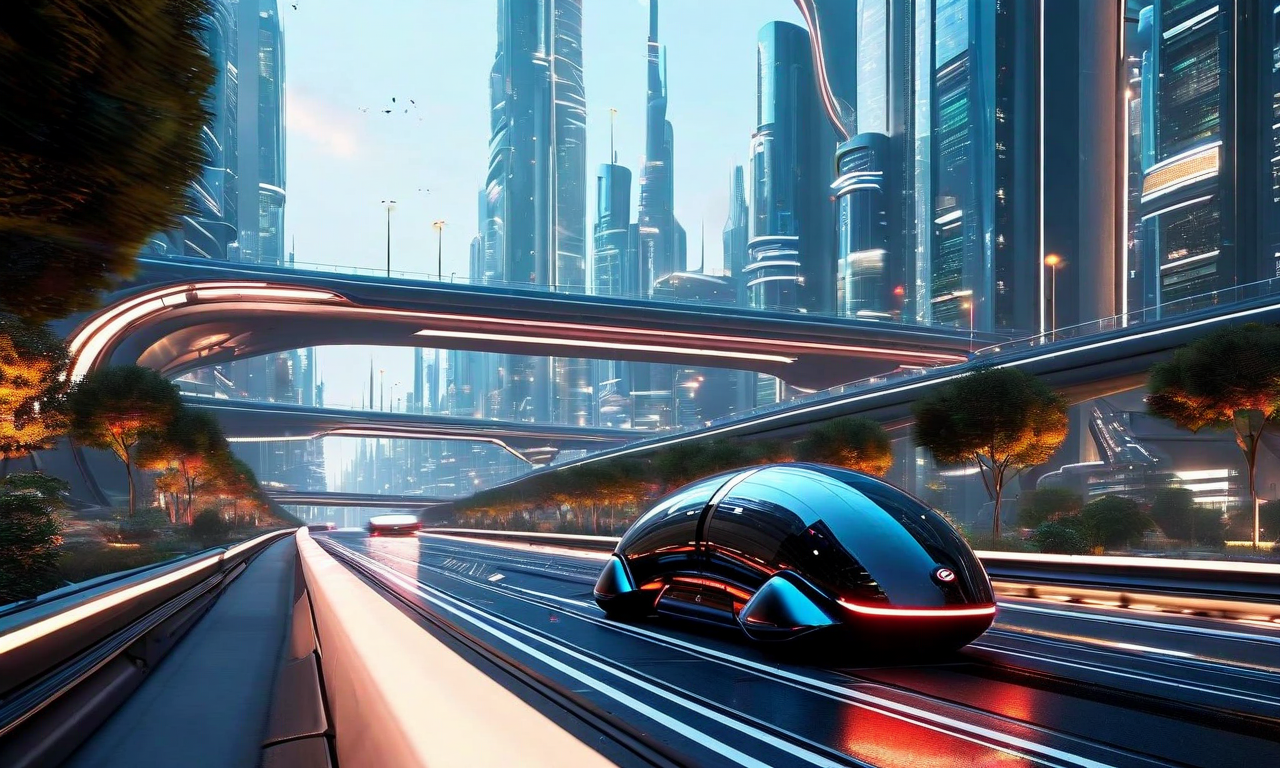
The daily commute is undergoing its most profound transformation in a century. Driven by advances in artificial intelligence, the rapid adoption of electric vehicles, and a post-pandemic reassessment of how and where people work, the journey from home to office is being reinvented in real time. Here is what the evidence tells us about where urban commuting is heading — and what it means for the millions of people who live it every day.
The Scale of the Problem
Before we can understand where commuting is going, we need to appreciate the full weight of where it has been. In the United States alone, commuters collectively spend roughly 100 billion hours per year traveling to and from work. That figure includes all modes of transport — driving, transit, cycling, and walking — but the car dominates, accounting for more than 85 percent of all commute trips.
Single-occupancy vehicle (SOV) commuting is the default for most Americans, and its costs are enormous. The average American spends about $10,000 per year operating a personal vehicle, with a significant portion of that cost attributable to commuting. Road congestion costs the US economy an estimated $87 billion annually in lost productivity and wasted fuel. And transportation — the single largest source of US greenhouse gas emissions — generates roughly 1.8 billion metric tons of CO₂ per year, with personal commuting representing a substantial share.
Cities, meanwhile, are being crushed under the weight of this car dependency. Urban land use in most American cities devotes 30 to 50 percent of all surface area to roads and parking. This is not an accident — it is the physical legacy of decades of policy decisions that prioritized the personal automobile above all other forms of mobility. Reversing those decisions requires both better technology and a fundamental shift in commuting culture.
Artificial Intelligence Is Rewriting the Rules
The most significant technological force reshaping commuting is artificial intelligence. AI is transforming commuting in at least three distinct ways: through dramatically improved route optimization, through predictive demand modeling, and through the social matching that makes shared mobility actually work for daily commuters.
Route optimization has existed in some form since the earliest GPS navigation systems, but modern AI-powered routing is qualitatively different. Today's systems ingest real-time data from thousands of sources — traffic sensors, weather feeds, incident reports, historical patterns, and even the aggregate movement data of smartphone users — to predict congestion with remarkable accuracy and suggest routes that save not just time but fuel and emissions. What used to require minutes of computation now happens in milliseconds, constantly recalculating as conditions change.
Predictive demand modeling is transforming how carpooling platforms match supply with demand. Rather than waiting for a driver and rider to both request a match simultaneously, modern AI systems anticipate when and where carpooling demand will arise — based on calendar data, historical patterns, and even local event schedules — and pre-positions matches before users even open the app. This predictive approach dramatically improves match rates and reduces the waiting time that frustrated early carpool users.
Social compatibility matching is perhaps the most underappreciated AI application in commuting. Early carpooling platforms treated people like packages — the only question was whether their routes overlapped. Modern systems, including GoPool's, use behavioral data and preference modeling to match commuters on a much richer set of dimensions: conversation preferences, music tolerance, punctuality patterns, and workplace community connections. The result is carpool relationships that people actually want to maintain over time, rather than awkward one-off encounters.
Electric Vehicles Are Changing the Economics
The rapid adoption of electric vehicles is reshaping the economics of commuting in ways that are only beginning to be understood. For individual commuters, EVs dramatically reduce per-mile operating costs — electricity is roughly 3 to 4 times cheaper than gasoline on a per-mile basis for most American drivers. This matters enormously for carpooling economics.
When the vehicle being shared is an EV, the per-person trip cost falls to levels that make carpooling attractive even for relatively short commutes. A round trip that might cost $8 in gasoline for a conventional vehicle might cost $2.50 in electricity for an EV — and when that cost is split between two or three riders, individual commuting becomes almost negligibly inexpensive. This changes the conversation about why people carpool from "I have to" to "why wouldn't I?"
EVs are also transforming the range anxiety question. Early electric vehicles were unsuitable for long-distance commuting due to limited range and slow charging infrastructure. By 2025, the average new EV has a range well above 250 miles, fast-charging networks have expanded dramatically, and workplace charging is increasingly common. For the typical American commuter traveling 30 miles or fewer each way, range is no longer a meaningful constraint.
The intersection of EVs and carpooling is particularly powerful. When multiple riders share an electric vehicle, the per-person carbon footprint of the trip approaches near-zero. A three-person carpool in a modern EV emits roughly 90 percent less greenhouse gas per passenger mile than a single driver in a conventional car. This is the combination that can genuinely move the needle on transportation emissions — not incremental improvements in individual vehicle efficiency.
The Post-Pandemic Commuting Landscape
The COVID-19 pandemic did not end the commute — but it fundamentally changed the commuting contract between employers and employees. The widespread adoption of hybrid work arrangements has created a new commuting reality for millions of office workers: they commute less frequently, but when they do commute, they want that experience to be as efficient and pleasant as possible.
This shift has profound implications for carpooling. When people commute on fixed days — say, Tuesday, Wednesday, and Thursday every week — their schedules become highly predictable, which is exactly the condition under which AI matching works best. A commuter who always travels on the same three days, from the same origin, to the same destination, at roughly the same time, is an ideal carpooling candidate. The unpredictability of irregular schedules was one of the primary reasons earlier carpooling platforms struggled to build sticky user behavior. Hybrid work arrangements largely solve that problem.
The pandemic also changed how people think about the value of their commute time. Years of remote work demonstrated that commuting time is not inherently "lost" — it can be productive, social, or restorative. Commuters who carpool consistently report higher satisfaction with their commute experience than solo drivers: conversation with colleagues, shared routines, and the simple pleasure of not having to concentrate on driving all contribute to a qualitatively different — and often better — commuting experience.
What This Means for Cities
The convergence of AI, EVs, and shared mobility is not just changing individual commuting behavior — it has the potential to reshape cities themselves. Every successful carpooling trip removes at least one vehicle from the road. At scale, this reduces congestion, cuts demand for parking, and lowers urban air pollution levels. Cities that actively support carpooling through preferential lane access, reduced parking charges for carpool vehicles, and employer incentive programs can accelerate these effects dramatically.
Several major American cities are already moving in this direction. High-occupancy vehicle (HOV) lanes, once a niche accommodation, are being expanded and increasingly enforced with automated detection systems. Some cities are experimenting with congestion pricing schemes that effectively tax single-occupancy vehicles entering busy corridors while providing rebates for verified carpool participants. These policy tools, combined with better technology, could create a genuine virtuous cycle: more carpooling leads to less congestion, which makes carpooling faster and more attractive, which drives further adoption.
The GoPool Perspective
At GoPool, we are building for this future — a future in which shared commuting is the default rather than the exception for millions of urban workers. Our AI matching platform, our focus on verified community connections, and our seamless cost-splitting technology are all designed to remove the friction that previously prevented carpooling from reaching mainstream adoption.
We believe we are at an inflection point. The technology is ready. The economics are compelling. The environmental imperative is urgent. What has been missing is a platform that makes shared commuting as easy and reliable as driving alone. That is what GoPool is building — and that is why we are excited about the next chapter of urban commuting.
This article was researched and written by the GoPool Research Team. Data sources include the US Department of Transportation, the EPA, and GoPool's internal platform analytics.