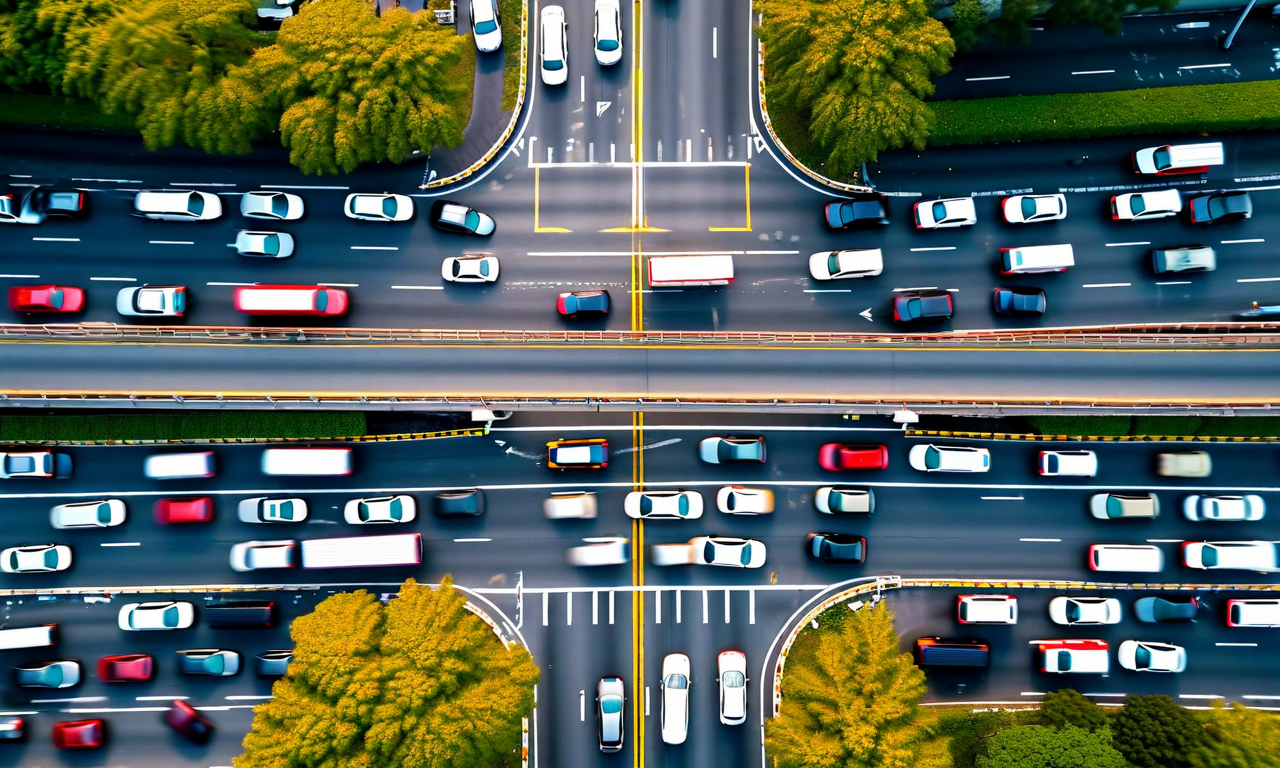
Traffic congestion costs the United States economy an estimated $87 billion annually in wasted time and fuel. The average American commuter loses 54 hours per year to traffic delays — more than a full working week. Can carpooling make a meaningful dent in this problem? The answer, backed by traffic modeling research, is yes — but only if adoption reaches a critical threshold. Here is what the evidence shows.
Understanding Traffic Congestion Dynamics
Traffic congestion is a non-linear phenomenon. Roads operate efficiently up to a certain capacity threshold — typically around 70-80 percent of rated capacity. Below that threshold, traffic flows smoothly and travel times are predictable. Above it, the system degrades rapidly. At 90 percent capacity, speeds drop significantly. At 100 percent capacity, the system can essentially lock up, with minor disruptions cascading into major delays that persist for hours.
This non-linearity is crucial for understanding the potential impact of carpooling. Because congestion gets dramatically worse near the capacity threshold, relatively small reductions in vehicle volume near that threshold can produce disproportionately large improvements in traffic flow. Traffic engineers refer to this as the "capacity sensitivity" effect: a 10 percent reduction in peak-hour vehicle volume on a congested corridor can produce a 30-50 percent reduction in peak delay times, because you are moving the system away from its worst operating point.
In practical terms, this means that widespread carpooling adoption does not need to eliminate the majority of solo commutes to produce dramatic improvements in congestion. It only needs to reduce peak-hour vehicle volumes enough to bring heavily congested corridors below their critical threshold. Research suggests that 15-20 percent reductions in peak-hour vehicle volumes in the most congested corridors could effectively eliminate the majority of severe congestion in most American metropolitan areas.
What the Traffic Models Show
Transportation researchers at several universities have modeled the congestion impact of various carpooling adoption scenarios for major metropolitan areas. Their findings are striking.
A 2023 study of the Los Angeles metropolitan area modeled the impact of increasing average vehicle occupancy from its current 1.14 persons per commute vehicle to 1.35 persons — a shift that represents approximately 20 percent of solo drivers forming carpool pairs. The model showed that this level of adoption would reduce peak-hour vehicle volumes on the most congested freeway corridors by 15-17 percent — enough to reduce average commute delays by 35-45 percent in the modeled scenarios.
A similar study of the New York-New Jersey commuter corridor found that 25 percent carpooling adoption among car commuters would reduce tunnel and bridge entry queue times by an average of 28 minutes during peak periods. The same study estimated that achieving this adoption level would save commuters collectively 420 million hours per year in the region.
The San Francisco Bay Area, where GoPool is headquartered, offers a particularly instructive case. The Bay Bridge and other key transit corridors already have high HOV lane utilization during peak periods. Bay Area Metropolitan Transportation Commission research suggests that raising average bridge commute vehicle occupancy from 1.17 to 1.40 — a 20 percent increase in carpooling adoption — would be equivalent to adding a full lane of capacity to the Bay Bridge during peak hours, without any infrastructure investment.
The Induced Demand Challenge
Any honest discussion of carpooling and congestion must acknowledge the "induced demand" problem. Economic research on transportation consistently shows that reducing congestion — whether through new road capacity or demand reduction — tends to attract new vehicle trips that would not have occurred under congested conditions. As travel becomes faster and easier, latent demand materializes, partially or fully offsetting the congestion reduction.
This is a real phenomenon, and it means that carpooling alone cannot permanently "solve" congestion if it is not paired with other demand management tools. However, the induced demand effect operates on a different timescale than the direct congestion reduction from carpooling — it typically takes months to years for new demand to materialize as people and businesses adjust their location and travel decisions. And the induced demand effect is typically less than 100 percent: a 20 percent reduction in vehicle volumes does not produce a 20 percent increase in new trips in the short to medium term.
More importantly, the goal of carpooling is not just to reduce congestion in isolation — it is to enable more people to travel on existing infrastructure at lower per-person cost and emissions. Even if some induced demand materializes, a world in which 40 percent of peak-hour vehicles carry two or more people is still a world with meaningfully lower per-capita congestion costs, emissions, and energy use than today's world of predominantly single-occupancy commuting.
Policy Levers That Amplify the Impact
The evidence suggests that the congestion-reduction potential of carpooling is greatest when it is supported by complementary policy measures that both encourage carpooling and discourage solo driving. Several such measures have proven particularly effective.
Congestion pricing — charging vehicles a fee to enter congested urban cores or corridors during peak hours — is the most direct and economically efficient tool for managing peak demand. When congestion pricing is combined with carpooling incentives (exemptions or discounts for vehicles with multiple occupants), it creates powerful financial incentives to carpool that operate precisely when and where congestion is most severe. Stockholm, London, and Singapore have demonstrated that well-designed congestion pricing schemes can reduce peak-hour traffic volumes by 20-30 percent sustainably over time.
HOV lane expansion and enforcement is a lower-cost alternative that many American cities have deployed with meaningful results. Converting general purpose lanes to HOV-only lanes during peak periods reduces total lane capacity but increases the throughput of people per lane, since each HOV vehicle carries multiple passengers. The net effect on person-throughput is positive when HOV occupancy rates are above approximately 1.6 persons per vehicle — a target that GoPool-style platform-enabled carpooling can achieve.
Parking pricing and availability management is another effective tool. When workplace parking is priced at its true market value — which in dense urban areas can be $20-50 per day — the financial incentive to carpool and share that parking cost becomes very strong. GoPool's cost-splitting algorithm explicitly tracks parking costs as a shared expense, making the parking savings of carpooling immediately visible to riders.
Why Carpooling Is Uniquely Suited to This Problem
Among the various demand management strategies for urban congestion, carpooling occupies a unique position. Unlike transit, which requires massive capital investment in infrastructure and operates on fixed routes and schedules, carpooling uses existing vehicles and roads. Unlike active transport alternatives (cycling, walking), it works for long-distance commutes and in geographies not served by safe cycling infrastructure. Unlike working from home, it does not require employers to restructure their workplace model.
Carpooling is also a supply-side solution that scales with demand in a way that infrastructure cannot. When more commuters want to carpool, the value of matching platforms like GoPool increases — more users means more potential matches, which means better match quality for everyone. This network effect is the opposite of the congestion effect: as more people participate in the solution, the solution gets better for all participants.
The traffic data confirms that carpooling, at meaningful adoption levels, can make a substantial dent in urban congestion. The question is whether platforms like GoPool can drive adoption to those levels. Based on our growth trajectory and the quality of our matching technology, we believe the answer is yes — and we are committed to demonstrating it one carpool at a time.
Traffic modeling data cited from published research by UCLA Institute of Transportation Studies, Rutgers Voorhees Transportation Center, and Metropolitan Transportation Commission Bay Area studies.